
New York City Cycling and E-bike Law FAQ
12 questions about riding in New York City: the e-bike rules, the roads and trails worth the trip, the season, and the events.
Questions and answers
What are the e-bike laws in New York City?
New York City layers its own rules on top of state law: a 15 mph speed cap for every e-bike on streets, bike lanes, and park paths since October 24, 2025, a sidewalk ban, and UL certification for any e-bike or battery sold in the city under Local Law 39 of 2023. State law still sets the three classes, the 16-year minimum age, and the rule that no license, registration, or insurance is required. Since March 27, 2026, low-level riding offenses draw civil summonses instead of criminal ones.
How are New York City's e-bike rules different from the rest of New York State?
The city keeps everything the state allows and adds its own layer. Two differences sit in state law itself: Class 3, the 25 mph throttle class, is legal only in a city of one million or more, so in New York City and nowhere else, and e-bikes elsewhere simply ride at their class limits of 20 or 25 mph while the city caps every e-bike at 15 mph under a NYC DOT rule since October 24, 2025. The city then adds a flat sidewalk ban with confiscation (NYC Admin. Code 19-176), UL certification for every e-bike and battery sold in the five boroughs (Local Law 39 of 2023), helmet, ID, and training rules for working cyclists (NYC Admin. Code 10-157), park access through the Parks pilot, and, since March 27, 2026, civil rather than criminal summonses for low-level riding offenses. What stays the same: no license, registration, or insurance is required in either, the minimum age is 16, and Class 1 and Class 2 definitions do not change at the city line.
How does the NYC 15 mph e-bike speed limit work?
The cap applies citywide to e-bikes, e-scooters, and pedal-assist commercial bicycles, whatever their class, and it matches the limit stand-up e-scooters already had. It came from a NYC DOT final rule published in the City Record in September 2025 and took effect October 24, 2025. The NYPD treats the cap as a secondary violation and, since March 27, 2026, handles it through the civil summons process used for motorists. Class 1, Class 2, and Class 3 e-bikes keep their state assisted-speed limits of 20, 20, and 25 mph, but on a city street 15 mph is the number that counts.
Do I need a license, registration, or plates to ride an e-bike in New York City?
You can ride any compliant e-bike in the five boroughs with no driver license, no DMV registration, and no plate, because state law (VTL Article 34-C and 102-c) leaves e-bikes out of the registration system. Priscilla's Law, which would require registration and plates in the city, is still a proposal, and the City Council left it out of the 23-bill package heard on October 1, 2026. Riders must be at least 16.
Who has to wear a helmet on an e-bike in New York City?
Every Class 3 rider wears a helmet regardless of age, and so does every rider under 14, under N.Y. VTL 1238. Working cyclists wear the helmet their employer is required to provide under NYC Admin. Code 10-157, along with a numbered ID card and business markings on the bike. Adults riding Class 1 or Class 2 e-bikes for their own purposes face no mandate.
Where can I ride a Class 1, Class 2, or Class 3 e-bike in New York City?
All three classes ride city streets and bike lanes at up to 15 mph, and park drives and greenways are open under the NYC Parks pilot that runs through December 31, 2026. Sidewalks are off-limits to every bicycle and e-bike (NYC Admin. Code 19-176), interior park paths are closed, and the Hudson River Park Trust bans e-bikes from its esplanade, piers, and bike path. Class 3, the 25 mph throttle class, is legal in the city and nowhere else in the state.
What are the NYC battery rules for e-bikes?
Any e-bike, e-scooter, or battery sold, leased, or rented in New York City must carry UL 2849, UL 2272, or UL 2271 certification under Local Law 39 of 2023, and reconditioned batteries built from salvaged cells cannot be sold. In August 2026 the city sent cease-and-desist orders to 42 online retailers selling devices over 750 watts or faster than 25 mph, with fines up to $2,000 per sale. Charge with the original charger, never overnight unattended, and never on a damaged or swollen pack.
What is the City Council planning for e-bikes?
The Council heard 23 micromobility bills on October 1, 2026: a ban on selling and renting Class 3 e-bikes (Intro 244), a trade-in program for illegal vehicles, commercial licensing, insurance, and data-sharing requirements for delivery platforms, and stiffer hit-and-run penalties. The Council cited 738 e-bike rider injuries and 13 deaths in the first half of 2026, up from 601 and 10 a year earlier. Registration and plates were left out, and none of the bills is law yet.
What are the best places to ride in New York City?
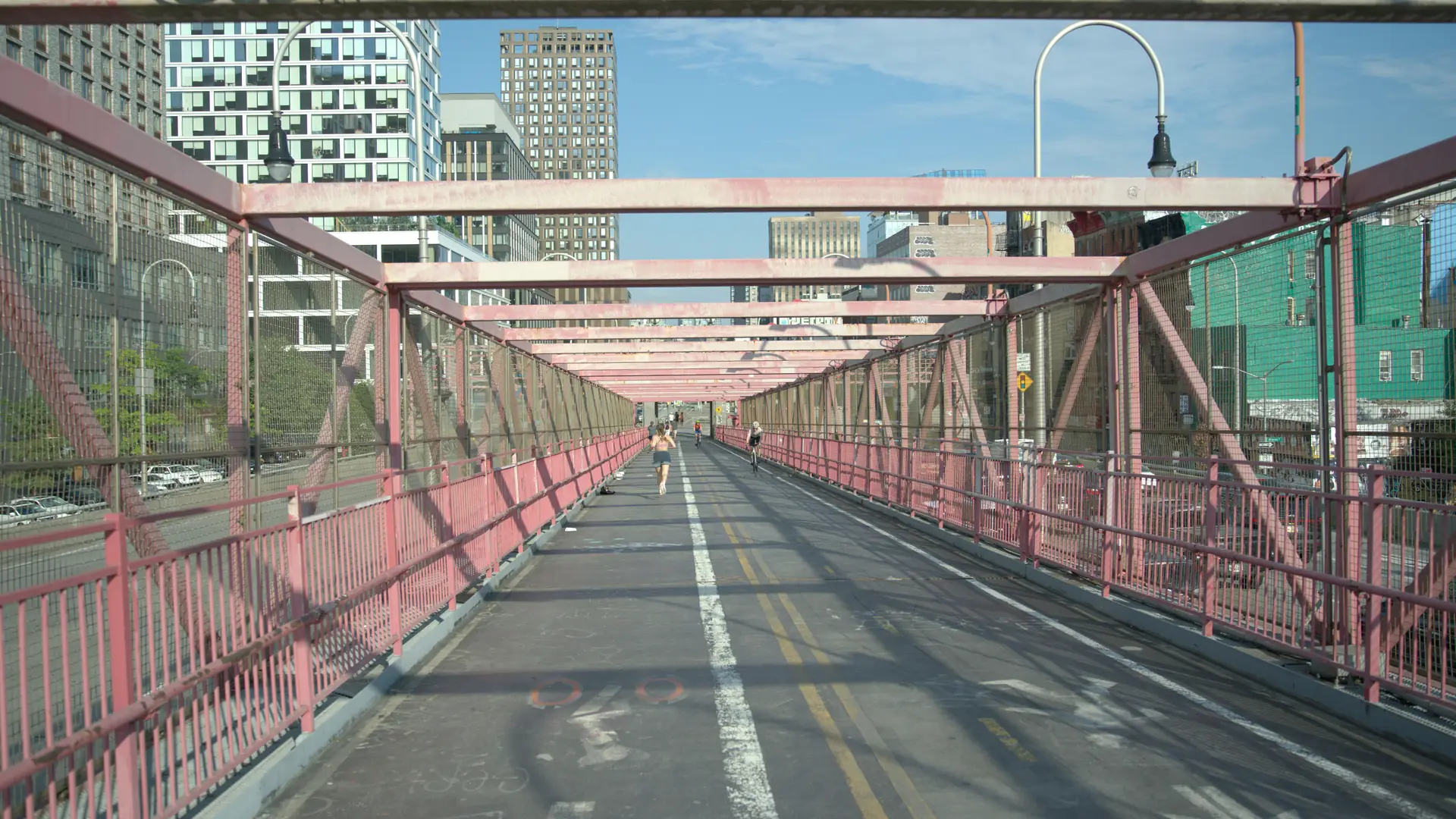
The Hudson River Greenway is the backbone, 13 car-free miles from Battery Park to the George Washington Bridge. The Central Park loop (6.1 miles) and the Prospect Park loop (3.4 miles) are the training circuits, the Brooklyn, Manhattan, and Williamsburg bridges each carry a bike path across the East River, and the Rockaway boardwalk, Governors Island, and the Shore Parkway greenway are the summer rides. Park drives and greenways are open to e-bikes under the Parks pilot; interior paths are not.
Which cycling events define the NYC calendar?
The Five Boro Bike Tour, the first Sunday in May, closes 40 miles of streets and bridges to cars for about 32,000 riders. The Harlem Skyscraper Classic is the Father's Day criterium that has run since 1973, the Gran Fondo New York heads up the Hudson in May, and the NYC Century Bike Tour in September strings all five boroughs together. Summer Streets opens Park Avenue to bikes on August Saturdays.
Can I take a bike or an e-bike on the subway and other public transit in New York City?
Yes. Regular bikes ride the subway at any hour: tap in, go through the service gate rather than lifting the bike over the turnstile, stand at the end of the car by the first or last doors, and skip rush hour if you can. E-bikes have been allowed on subways, buses, and the commuter railroads since the MTA's April 2023 personal electric vehicle policy, with conditions: the bike must be switched off and carried, not ridden, in stations; the battery must be UL-certified and undamaged; the device must weigh under 100 pounds; charging is banned anywhere on MTA property; and shared or rented bikes stay out. Buses take only folded folding bikes on local and SBS routes, with front racks on seven routes, and no bikes or e-bikes on express buses. LIRR and Metro-North dropped the bike permit in 2021 but bar non-folding bikes at rush hour and on some holidays and cap them at four per weekday train and eight on weekends. The Staten Island Ferry carries bikes free from the lower level, walked not ridden, and allows e-bikes with pedals but not electric mopeds; NYC Ferry also welcomes walked bikes. Charging is prohibited on every ferry too, and PATH sets its own rules, so check before you cross the river.
How do I keep my bike from being stolen in New York City?
Lock the frame and rear wheel to a fixed rack with a hardened U-lock or chain, add a second lock of a different type, take the lights, and never leave an e-bike on the street overnight. NYPD data for the first half of 2026 counted 1,766 thefts citywide, with Manhattan the highest-rate borough at 45 per 100,000 residents, most thefts on the street, and the busiest hour between 8 and 9 p.m. The NYPD registers and engraves bikes for free, and a photographed serial number is what gets a recovered bike back.
Law summaries are current as of October 2026 and are not legal advice; see the New York City e-bike and bicycle laws page for statutes. Trail and event details change; check the organizer or land manager before you go.